
Biking into Yorktown
Crossing the USA

The morning sun shimmered on the Chesapeake Bay, heat rising from the asphalt as our tires rolled smoothly along the final stretch of the Colonial Parkway. After nearly three months and over three thousand miles, it was hard to believe we were pedaling the last few miles.
“There,” Liz said, pointing ahead.
The sign emerged from a blaze of red maple ahead of us:
Welcome to Historic Yorktown
Site of the British Surrender — 1781
I felt something break open in my chest, pride, relief, and a sudden hush inside me, like church doors swinging open. Yorktown was the eastern terminus of the TransAmerica Bike Trail we’d followed across the country. It felt profound to end our cross-country ride at the place where America had won its independence.
“You know,” Liz said, coasting beside me, “Bryce is going to get such a kick out of this.”
Earlier that summer, Colonel Bryce Hollingworth (retired) had been just another guest on one of Liz’s Alaska tours, a distinguished gentleman in his eighties who covered ground with the steady determination of someone accustomed to completing missions. Over campfires in Talkeetna and Denali, he’d shared stories of designing American embassies around the world during his Air Force career, each one a small fortress of democracy on foreign soil.
“Kabul, Baghdad, Nairobi,” he’d told Liz one evening, watching the rushing waters of the Nenana River. “Every embassy was a statement: America stands here. Sometimes they are in dangerous places. Sometimes it made you a target.” He’d paused, stirring the fire with a stick. “But you build them anyway, because we stand for something.”
When Liz mentioned our cross-country cycling plan, his eyes had lit up. “Well, I’ll be damned. Yorktown’s my backyard these days. You finish that ride, you look me up. Anita and I will throw you a proper welcome.”
Now, three thousand miles later, his business card was tucked in Liz’s handlebar bag, dog-eared from the journey.
The sound of drums echoed ahead of us.
“What’s that?” Liz asked.
We rounded a corner to find Main Street closed, crowds lining the sidewalks, and a parade forming. A teenager in a tricorn hat was adjusting a banner.
“It’s Yorktown Day!” he called to us. “Two hundred twenty-fifth anniversary of the surrender!”
We looked at each other and burst into laughter. We’d planned to arrive around this date, but the exact timing felt like a gift.
I flashed back to Kansas, when prairie winds shoved us sideways all day and we managed only seven miles in three hours. The memory made me shudder. Now, to roll into Yorktown on a day of celebration felt like the wind had changed.
A woman in a reflective vest approached us, clearly a parade organizer. “You two part of the procession?”
“Actually,” Liz grinned, “we just rode here from Oregon.”
The woman blinked. “Wait—bicycled?”
“Coast to coast” I confirmed, still catching my breath.
Her face lit up as if we’d just unearthed a chest of Revolutionary coins. “Well, get in line behind the Fife and Drum Corps. Just don’t pass the horses.”
And so we joined the parade. Our bikes clicked gently over the cobblestones as fifes played ahead of us and drums marked time behind. The crowd didn’t know who we were, but they clapped anyway, perhaps sensing something different about the two dust-covered cyclists with overstuffed panniers and sun-weathered faces.
“Way to go!” someone shouted.
A little girl ran up and handed me a small American flag, then darted back to her parents, giggling.
It was ridiculous and perfect and overwhelming. I found myself crying and laughing simultaneously as we rolled through the heart of this historic town, completing our own version of an American revolution.
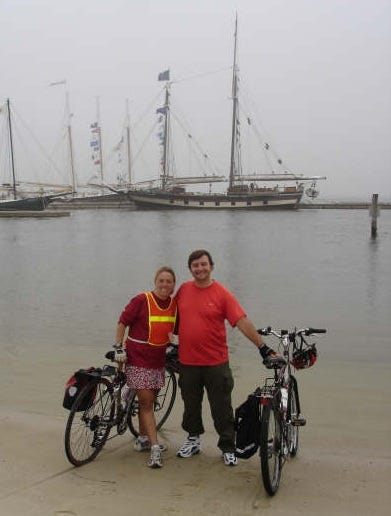
After the parade, we went down to the James river and dipped our tires in the water as we had done in Florence Oregon nearly 3 months before,
A woman approached with a camera and reporter’s pad.
“Lorraine McKay, Yorktown Herald,” she introduced herself. “Word is you just finished quite a journey.”
She lined us up with our bikes and took our photo.
“What made you do it?” she finally asked.
I glanced at Liz, then up at the replicas of the boats that had founded Jamestown.
“To see the country the slow way,” I said. “To feel the ground beneath the story.”
Lorraine smiled and closed her notepad. “I’ll send you a clipping.”
We called Bryce from the visitor center, and his voice boomed through the phone speaker. “By God, you actually did it! Anita’s making her famous crab cakes as we speak. Get yourselves over here.”
The Hollingworth house sat on a tree-lined street, brick and shutters speaking of old Virginia money. Inside, everything carried the squared-off neatness of a man who’d lived by military order. Bryce answered the door in khakis and a polo shirt, but his bearing still carried decades of command presence. In his eighties, he was tall and straight-backed, with sharp blue eyes that missed nothing.
“Well, look what the road dragged in,” he grinned, embracing us both. “Anita! The cyclists are here!”
Anita appeared from the kitchen, a woman of equal vintage with silver hair and the kind of warm smile that charmed diplomats and generals. “Welcome, welcome! You must be starved. When did you last sit down to a meal that wasn’t trail mix or gas-station pizza?”
As we showered and changed into our cleanest travel clothes, I could hear them talking in the kitchen, Liz had told they’d met late in life, they were practically newlyweds like ourselves. They had both lived overseas with the military and had a lifetime hosting unexpected guests in foreign countries, making strangers feel at home. Representing their country with elegance and grace.
“You know,” Bryce said over dinner, “there’s a big anniversary celebration tonight. Fireworks, ceremony, the works. Some of my old colleagues are in town. Would you like to join us?”
We arrived at the waterfront as the sun was setting, expecting to find spots in the general crowd. Instead, Bryce led us past security checkpoints with casual nods to uniformed personnel who clearly knew him well.
“Colonel, sir,” a young Marine said, snapping to attention. “Your party’s expected at the VIP area.”
We found ourselves in the front row of a roped-off section filled with military brass and political dignitaries. I felt absurdly underdressed in our zip-off trousers and least-smelly t-shirt a jarring contrast to rows of pressed uniforms and polished medals. Bryce and Anita introduced us around as if we were visiting heads of state.
“These are the cyclists I told you about,” Bryce said to a three-star general. “Just finished riding across the country. Oregon to Virginia.”
“Congratulations,” the general nodded approvingly. “What an amazing trip.”
As the ceremony began, with speeches about sacrifice and freedom, I understood why Bryce had been so moved by our journey. We’d been exploring the country he had dedicated his life to, rediscovering what made it worth defending.
When the fireworks exploded over the York River, painting the water in red, white, and blue, Bryce leaned over. “This is the America worth fighting for,” he said quietly. “Not the one you see on the news, but the one you find when you slow down enough to meet your neighbors.”
The rockets burst overhead, reflecting in the water like fallen stars.
Back home in Washington, autumn arrived with its familiar darkness and rain. Our bikes sat in the garage, still dusty, their odometers frozen at numbers that seemed almost fictional.
Sometimes I’d walk past and run my hand along the handlebars, half-convinced we’d dreamed the whole thing.
Then one gray afternoon, a manila envelope arrived in the mail. Inside was a newspaper clipping from the Yorktown Herald:
“Victory Ride: Cross-Country Cyclists Reach Yorktown on Historic Anniversary”
There we were in grainy black and white—standing with our bikes, grinning like fools, with the ships in the background and October sun in our eyes. We looked exhausted and exhilarated and absolutely certain we’d just done something that mattered.
But tucked behind the newspaper clipping was a handwritten note on newspaper letterhead:
“Thank you for sharing your story. —L.McK.”
I stuck both pieces on the refrigerator, right beside our old paper map where a thin red line still traced its way from sea to shining sea.
I stepped back, arms folded, and whispered to the map: “From sea to shining sea.”
Some journeys change you mile by mile. The best ones, the ones worth taking, show you the country’s heart, in strangers who hand you flags, in new friends who save you a seat beneath the fireworks, in the discovery that America is still worth crossing slowly, one revolution at a time.
I love this Michael. Just the story I needed to read right now too. It feels good to believe in this kind of USA, that maybe it still exists. Big hugs to you and Liz.
Another great life story ! I agree, we all needed this today...So very uplifting. Thank you for sharing once again.