
Black Tot Day: The Day the Royal Navy Buried Its Rum
The end of a tradition that defined life on board for over 300 years

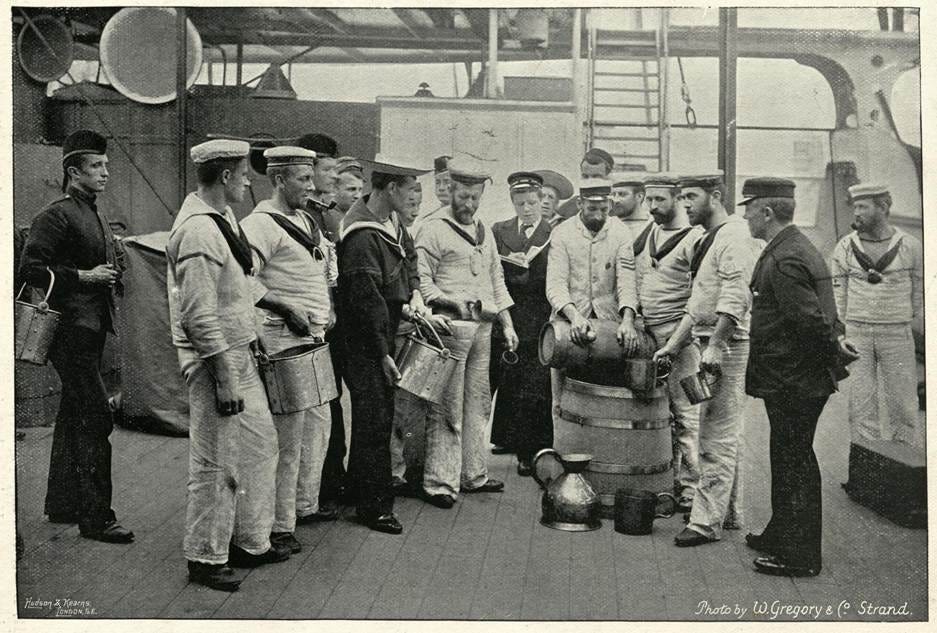
On July 31, 1970, something quietly monumental happened aboard all ships of the Royal Navy scattered around the remnants of the British Empire. At exactly 11:00 a.m. the call rang out:
“Up spirits.”
For a brief moment the ordinary sounds of the ship seemed to pause: engines humming below deck, boots against steel, the hiss of sea wind along the rail.
This call had been heard on ships of the Royal Navy for centuries, but this time, it was the last.
The smell of navy rum drifted across the deck as the cask was opened: molasses, alcohol, and oak, familiar to sailors long before anyone aboard had been born.
One uniformed sailor pumps rum from the cask into a bucket. The bucket of rum is then poured into a barrel of water. Another officer uses a huge dipper with a 5 foot handle to stir up the rum in the barrel.
Then sailors line up with buckets, one for each detachment. The officer fills the buckets with the mixture of rum and water as the line moves through. The buckets are shared among the men with a solemn sense of history.
That final issue of rum marked the end of a tradition that had shaped naval life since 1655. Sailors called it Black Tot Day, and they didn’t let it pass unnoticed.
Water in medieval times was often contaminated and not safe to drink. Low-alcohol “small beer” resisted bacterial growth better than stored water.
Fresh water in barrels deteriorated quickly, especially in warm climates or on long voyages. Beer spoiled too but generally lasted longer and was more palatable.
By the time of the Tudor navy under Henry VIII in the early 1500s, beer was already a standard naval provision. In fact, beer was so central to shipboard life that naval logistics were often planned around it.
The quantities were astonishing by modern standards. Sailors could receive up to ten pints of weak beer per day. This was not modern-strength ale, “small beer” was about 1-2% alcohol.
Beer also served another important purpose: calories.
Life aboard a warship was brutally physical. Sailors climbed rigging slick with rain and tar, hauled wet rope until their hands split open, and cannon crews worked in suffocating heat below deck. Beer functioned partly as liquid food, helping sustain men through exhausting labor and poor diets.
Beer, however, had major logistical disadvantages. Chief among them was the sheer amount of space it required.
Naval provisioning records from the Tudor and Stuart periods show how massive beer consumption really was. A fleet preparing to sail might load thousands of barrels of beer alongside salted beef, biscuit, cheese, and dried peas. Supplying beer was one of the Navy’s largest logistical tasks.
In warm climates the barrels could turn quickly. Beer soured, water grew stagnant, and sailors sometimes drank with one hand covering their nose against the smell. On long voyages, a ration that could survive months at sea without spoiling became more than a convenience, it became a necessity.
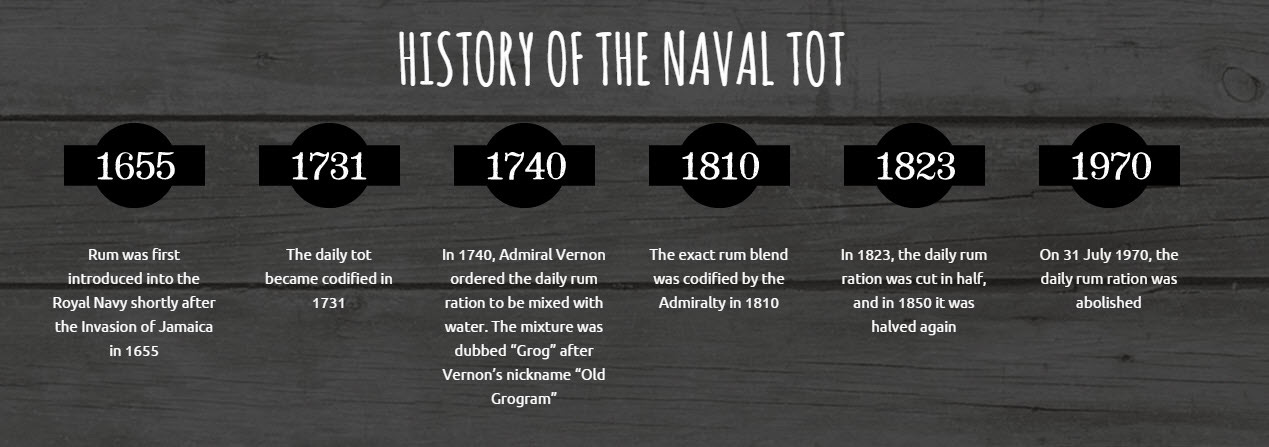
As England expanded overseas, especially into the Caribbean, stronger distilled spirits became more practical. This started with gin, but after England captured Jamaica in 1655, rum became abundant and cheap within Britain’s imperial trade network. The daily rum ration, known as the tot, was introduced in 1655.

Rum eventually replaced beer as the primary spirit ration because it lasted indefinitely, required less storage space and transported efficiently.
When first introduced, sailors received a half-pint of rum per day. This was not refined sipping rum by modern standards. Naval rum was powerful, rough liquor, often around 100 proof. It was seen as essential for morale given the brutal conditions on board.
However, it led to problems. The sailors would drink it quickly and get drunk or hoard it for a few days and drink it all at once. This caused drunkenness, accidents, poor discipline, and operational problems aboard ship.
In 1740 Admiral Edward Vernon introduced reforms to the system. He ordered sailors to dilute the rum with water and mix it with lime or lemon juice and sugar. And most importantly the sailors must consume it under supervision. No more hoarding.
The total alcohol allocation remained but diluting it slowed consumption and reduced immediate drunkenness. It was a practical compromise.
The ration was rarely consumed alone. Messmates gathered around battered tubs and shared the drink together, turning it into a daily act of camaraderie.
Edward Vernon was nicknamed “Old Grog” by sailors because he frequently wore a cloak made from grogram cloth, a coarse silk-and-wool fabric. The nickname was transferred to the diluted rum itself. So, “Old Grog’s drink” became simply grog.
Over time, the ration was reduced. What began as a half-pint became just one-eighth of a pint (about 70 ml) by the mid-19th century.
Yet the tradition endured through the transition from sail to steam, and later into the age of radar, missiles, and nuclear submarines.
By the late 1960s, naval technology had transformed warfare at sea. Modern warships relied on increasingly complex electronic systems and rapid-response operations. Concerns grew that daily alcohol consumption no longer matched the standards required of modern sailors.
In December 1969, the Admiralty Board announced that the rum ration would end.
The decision sparked what became known as “The Great Rum Debate” in the British Parliament. Among those defending the tradition was MP James Wellbeloved, who argued that rum strengthened morale and fighting spirit.
But the decision stood.
The tot would disappear.
When Black Tot Day arrived, sailors understood they were witnessing the end of something larger than a daily drink. The tot had become ceremony.
It marked a pause in the rhythm of naval life. It connected modern sailors to generations who had crossed oceans under sail, fought wars, survived storms, and served aboard ships made of wood rather than steel.
Sailors didn’t treat it like an ordinary day. Across the fleet, they marked the moment with a mix of humor, defiance, and genuine grief. The final tots were issued with unusual ceremony. In some cases, officers even read formal statements.
Some sailors wore black armbands. Others staged mock funerals for the rum ration. At the Royal Naval Electrical College, a full funeral procession was held, complete with a coffin. Sailors marched behind the black cloth draped coffin while others stood silently at attention, half amused and half sincere in their mourning.
The tot was a ritual that cut across all ranks and represented a tangible link to sailors stretching back centuries. The daily pause in the rhythm of naval duty had defined the life of sailors for over 300 years.
Sailors who gave up the tot were compensated financially, in what became known as “grog money.” And rum itself remained tied to naval identity, just no longer part of the daily routine.
Today, Black Tot Day is still remembered by naval historians, enthusiasts, and former sailors. Commemorative bottles of navy rum are produced, and the story continues to fascinate people far beyond maritime circles.
Part of that fascination comes from the sheer improbability of it all: a centuries-old institution issuing daily rum aboard armed warships well into the modern age.
Black Tot Day marked the moment when the modern Navy finally severed one of its oldest living links to the age of sail.
Thank you Michael! I loved this story. I did not know how the grog issue stopped in the Royal Navy.
Now I am curious what happened to beer. Was it stopped too? Did refrigeration save it? As a beer guy, I’m dying to know. When I was in the US Navy we could only have a 3.2% beer on a ship if you were kept out to sea for an extended deployment. Do the Brits get a beer more often?