
Rob Roy - the legend, the cocktail
Scotland’s Answer to the Manhattan

Today, the story of the Rob Roy cocktail. Enjoy.
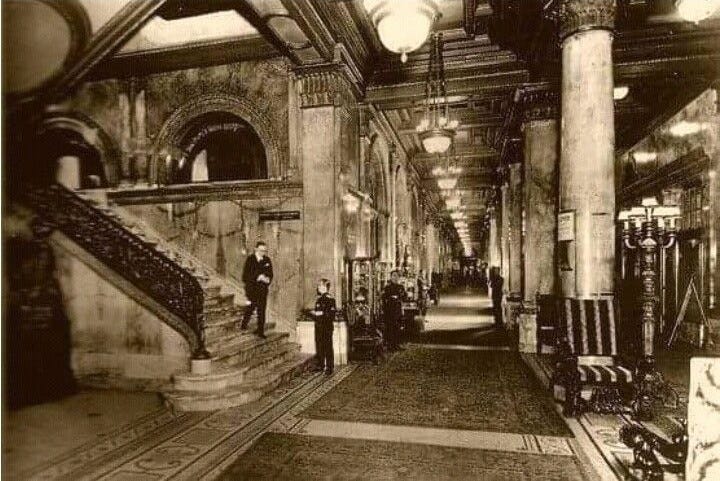
The Waldorf swallowed her the moment she stepped inside—thick carpets muffling her steps, smoke curled heavy enough to taste, the chandeliers buzzing with that new electrical hum that always made her uneasy.
This was not a place for women like her. Not unless they belonged to someone.
A bellman approached without a word, holding out a calling card she recognized instantly.
Lord Alistair Kinross.
He was here. Of course he was.
She had left the theatre only twenty minutes earlier. He must have walked fast, coat pulled tight, impatience disguised as purpose. Or perhaps he’d come straight from his private box, avoiding the crowds entirely, calculating exactly how long it would take her to reach him.
He was good at calculation.
The Waldorf Bar glowed in dark amber as she entered—cigars, expensive cologne, low male laughter that always rasped along her nerves. The bartender noticed her first, gave the smallest tilt of his chin, and the nearest patrons parted just enough for her to pass through.
Then she saw him.
Kinross sat alone in the corner, wearing the expression he reserved for her—controlled, but edged with heat, like coals banked under ash. His eyes tracked her across the room, unhurried, owning the space between them long before she reached him.
Isla felt it. The familiar drop in her stomach, the tug low in her body she hated herself for. She had been in his bed just two nights earlier, his hand over her mouth to keep her quiet in the rented room on 28th Street, the window rattling with winter wind. She had left before dawn, hair unpinned, throat bruised from both the stage and from him.
And now here he was, immaculate again, polished back into the man the world respected.
“Isla,” he said as she reached the table. Just her name. Heavy with everything they never said in daylight.
“My lord.”
He smiled and gestured to the chair across from him. Even that small motion felt proprietary. Possessive.
The bartender brought her a drink without being asked.
A new one. Dark, sweet, unfamiliar.
“A Rob Roy,” the man murmured. “House debut. Named for your show.”
She lifted it, letting the scent rise: peat, vermouth, something sharp beneath. Scotland buried under sweetness.
Kinross didn’t wait. He rarely did with her.
“I want you to come to Edinburgh,” he said quietly.
Her hand stalled mid-lift. The glass trembled.
“Edinburgh?” she repeated, as if the word were foreign.
He leaned forward, lowered his voice so only she could hear.
“You know what I mean. Not a visit.”
His gaze pinned her. “A life.”
There it was.
No velvet around it. No pretense.
No pretending she was only his lover in secret rooms and hurried evenings.
A life.
She set the drink down before she spilled it.
“My lord—”
“Alistair.” His voice hardened just a fraction. “In private, you call me Alistair.”
She swallowed. “Alistair… I have my work. The opera. The tour. What you’re suggesting—”
“Is what we already are,” he cut in. “Without the squalor of boarding houses and rented rooms. Without you slipping through back doors at dawn. Without danger.”
He reached across the table, stopping inches short of her hand. He never touched her in public. That was part of the arrangement. Part of the control.
“In Edinburgh,” he said, “you would be safe. You would be kept. Protected. Wanted.”
Protected.
She almost laughed.
“And your wife?” she asked.
He didn’t flinch.
“She has her world. I have mine.”
“And I would be…?”
His pause told her everything, long before he spoke.
“Established,” he said. “Comfortably. Discreetly.”
The word she refused to say—mistress—hung between them like a blade.
Her stomach twisted. Not with shock; she’d known this moment was coming since the first time she let him undress her. But hearing it spoken aloud made it real, heavy, inescapable.
He watched her, calm, certain.
As though he had already decided she would agree.
“I can give you influence,” he said. “Connections. A home. Lessons with the best masters in Europe. Money enough that you never have to fear the whims of men like your director or your critics.”
His voice dropped, darkening.
“And you know what it would be between us. You know.”
Heat curled through her, unwelcome and undeniable. He saw the flicker in her eyes and pressed on softly:
“Come with me, Isla. Leave this city. Come where you are mine… and no one has to pretend otherwise.”
She closed her eyes.
Around them, the bar carried on—deals whispered, glasses clinked, the New York elite oblivious to the cage being built around her in real time.
She opened her eyes and looked at him.
The man who owned her body.
The man who wanted to own her life.
“Say yes,” he murmured. “And I’ll take you away from all of this.”
Her breath caught.
The Rob Roy sat untouched on the table, glowing faintly under the lamplight—dark, sweet, dangerous.
Just like him.
Just like the choice he was asking her to make.

The Rob Roy has a great origin story. When Broadway’s lights first illuminated Reginald De Koven’s operetta Rob Roy in 1894, audiences witnessed the birth of a cocktail that would become whisky’s most sophisticated ambassador. Named after Scotland’s legendary outlaw-turned-folk hero, the cocktail known as the Rob Roy emerged from the Waldorf Hotel’s bar as a distinctly Scottish take on the Manhattan, a drink that traded American whiskey for Scotch and carved out its own place in cocktail lore.
Robert Roy MacGregor, born in 1671 in the Scottish Highlands, was far more complex than the romanticized “Scottish Robin Hood” of later legend. A cattle dealer and clan chief, Rob Roy found himself caught in the turbulent politics of early 18th-century Scotland, where clan loyalties, English rule, and Jacobite sympathies created a volatile mix. When the Duke of Montrose seized his lands in 1712 after a business dispute, MacGregor turned to cattle raiding and became a wanted outlaw. His exploits, stealing from wealthy landowners, evading capture, and eventually receiving a royal pardon, made him a folk hero even during his lifetime.
Sir Walter Scott’s 1817 novel Rob Roy transformed the historical figure into a romantic symbol of Scottish resistance and honor, cementing his place in popular imagination. By the time De Koven’s operetta premiered at the Herald Square Theatre in New York on October 29, 1894, Rob Roy had become synonymous with Scottish pride, courage, and a certain roguish charm.
The operetta’s premiere was a major theatrical event in Gilded Age New York. The production ran for nearly 300 performances, an impressive feat for the era, and featured elaborate Scottish Highland settings, traditional costumes, and romanticized depictions of clan life. The show capitalized on America’s fascination with all things Scottish—a trend that had been building throughout the 19th century as Scottish immigrants brought their culture to American shores.
The Waldorf Hotel, which opened just the year before, in 1893, at Fifth Avenue and 33rd Street, was the perfect birthplace for such a drink. This wasn’t just any hotel, it was the hotel, the most luxurious establishment in New York and perhaps all of America. Created by William Waldorf Astor (who’d move to England and eventually become a Viscount), the Waldorf set new standards for opulence and service. Its Palm Garden, where orchestra music drifted through fronds while society’s elite took tea, and its Empire Room, where thousand-dollar dinners were commonplace, defined Gilded Age excess.
Behind the bar stood men who were as much artists as bartenders. While we don’t know exactly which bartender created the Rob Roy, it emerged from a culture of innovation at the Waldorf’s bar, where skilled mixologists regularly created drinks to commemorate current events and celebrity guests. The hotel’s barmen understood that their wealthy clientele expected not just drinks, but experiences, liquid conversation pieces that connected them to the cultural moments of their time.
The Rob Roy’s creation followed a well-established tradition of commemorative cocktails. Naming a drink after a popular theatrical production was both a marketing stroke and a genuine tribute. The operetta’s success meant that anyone who ordered a Rob Roy could feel connected to the cultural zeitgeist, carrying a piece of Broadway sophistication wherever they drank.
The drink’s composition was elegantly simple: Scotch whisky replacing the rye in a Manhattan, sweet vermouth, and Angostura bitters. This substitution was more revolutionary than it might appear. Scotch whisky, particularly the blended varieties that were becoming available in America during the 1890s, offered a completely different flavor profile from American rye. The smoky, sometimes peaty notes of Scotch, combined with its characteristic smoothness, created a drink that was simultaneously familiar and exotic.
The timing coincided perfectly with Scotch whisky’s growing presence in the American market. Throughout the late 19th century, Scottish distillers had been perfecting the art of blending—combining single malts with grain whiskies to create consistent, approachable products that could survive the journey across the Atlantic and appeal to American palates. Brands like Dewar’s and Johnnie Walker were establishing themselves, and bartenders were eager to showcase these imported spirits in sophisticated cocktails.
The Rob Roy found its audience among New York’s upper crust, who appreciated both its theatrical connection and its refined character. Unlike the bolder, more assertive Manhattan, the Rob Roy offered something gentler, more contemplative—a drink for savoring rather than gulping, perfectly suited to the leisurely pace of Gilded Age hotel bars and gentlemen’s clubs.
As the 20th century progressed, the Rob Roy evolved. The “Perfect Rob Roy” emerged, splitting the vermouth between sweet and dry, creating a more balanced, less sweet profile. The “Dry Rob Roy” went further, using only dry vermouth for a drink that emphasized the Scotch’s character. These variations allowed the cocktail to adapt to changing tastes without losing its essential identity.
Prohibition nearly killed the Rob Roy, as it did many classic cocktails. The few bottles of aged Scotch that remained in America during the “Noble Experiment” were too precious to mix into cocktails. But the drink survived in speakeasies and, perhaps more importantly, in the memories of those who had enjoyed it during the pre-Prohibition golden age.
The cocktail’s revival after Prohibition was slower than some classics. The 1930s through 1960s belonged to gin, martinis ruled the three-martini lunch, and vodka was beginning its inexorable rise. The Rob Roy became something of a gentleman’s drink, ordered by older patrons who remembered the pre-Prohibition era or by those with a taste for whisky-based cocktails. It never disappeared entirely, but it certainly lost the spotlight it had once enjoyed.
The late 20th century wasn’t kind to many classic cocktails, and the Rob Roy suffered along with others. The 1970s and 1980s saw drinking tastes shift toward lighter, sweeter, and more colorful drinks. Vodka became America’s dominant spirit, and brown spirits generally fell out of favor. The Rob Roy, with its austere appearance and whisky-forward character, seemed like a relic from another era.
But the craft cocktail renaissance of the early 21st century brought the Rob Roy roaring back. As bartenders rediscovered classic recipes and techniques, they found in the Rob Roy a perfect template for showcasing quality ingredients. The explosion of single malt Scotch availability in the American market created new possibilities—bartenders could craft Rob Roys with peaty Islay malts for a smoky, intense drink, or use smooth Speyside whiskies for something more delicate.
Modern bartenders have embraced the Rob Roy’s versatility. Some use premium aged vermouths that bring their own complex flavors to the drink. Others experiment with different bitters—orange bitters for a citrus note, chocolate bitters for depth, or aromatic bitters for a more perfumed quality. The garnish, too, has evolved beyond the simple cherry, with some bars using branded cherries, orange twists, or even smoking the glass with a torch for added drama.
The Rob Roy has also become a vehicle for exploring Scotland’s diverse whisky regions. A Rob Roy made with an Islay Scotch like Laphroaig creates a completely different drink than one made with a Highland malt like Glenmorangie or a Lowland whisky like Auchentoshan. This versatility has made the cocktail popular among whisky enthusiasts who appreciate how the drink’s structure allows different Scotches to express their unique characteristics.
In Scotland itself, the Rob Roy has an interesting status. While cocktail culture arrived later to Scotland than to America, modern Scottish bartenders have embraced the drink as part of their heritage. Edinburgh and Glasgow now boast world-class cocktail bars where the Rob Roy is treated with the reverence it deserves, often made with local single malts and presented as both a piece of history and a contemporary classic.
The drink’s enduring appeal lies partly in its simplicity, it’s a Manhattan with Scotch, easy to remember and execute, but also in its sophistication. A well-made Rob Roy requires quality ingredients and proper technique. The whisky must be good enough to shine through, the vermouth fresh enough to contribute its herbal, wine-based complexity, and the bitters measured precisely to provide depth without overwhelming. It’s a drink that rewards attention to detail.
Today’s Rob Roy stands as a testament to cocktail culture’s cyclical nature. Born in the Gilded Age’s theatrical excess, surviving Prohibition and mid-century neglect, and reborn in the craft cocktail era, it represents more than 125 years of drinking history. Each sip connects us to those theater-goers of 1894, to the skilled bartenders of the Waldorf, and to Scotland’s enduring gift to the world of spirits.
Like its namesake outlaw, the Rob Roy has proven adaptable, resilient, and ultimately triumphant. It remains what it’s always been: Scotland’s sophisticated answer to the Manhattan.
The Classic Recipe:
2 oz Scotch whisky (traditionally a blended Scotch)
1 oz sweet vermouth
2-3 dashes Angostura bitters
Garnish: brandied cherry or lemon twist
Method: Stir ingredients with ice until well-chilled (about 30 seconds). Strain into a chilled cocktail glass or coupe. Garnish with a brandied cherry or lemon twist.
Variations:
Perfect Rob Roy:
2 oz Scotch whisky
½ oz sweet vermouth
½ oz dry vermouth
2 dashes Angostura bitters
Dry Rob Roy:
2 oz Scotch whisky
1 oz dry vermouth
2 dashes Angostura bitters
Garnish: lemon twist
Tips:
Use a quality blended Scotch like Dewar’s, Famous Grouse, or Johnnie Walker Black for the traditional recipe
Experiment with single malts for more distinctive flavors—Highland malts work particularly well
Fresh vermouth is essential—refrigerate after opening and use within a few months
Stirring (not shaking) maintains the drink’s clarity and silky texture
A proper chill is crucial—never rush the stirring process
I loved this historical piece about Rob Roy and the cocktail named after him. I’ll have to try it someday when I have the opportunity to visit a sophisticated cocktail bar either here in the US or, better yet, in Scotland. Cheers!
Linda A