

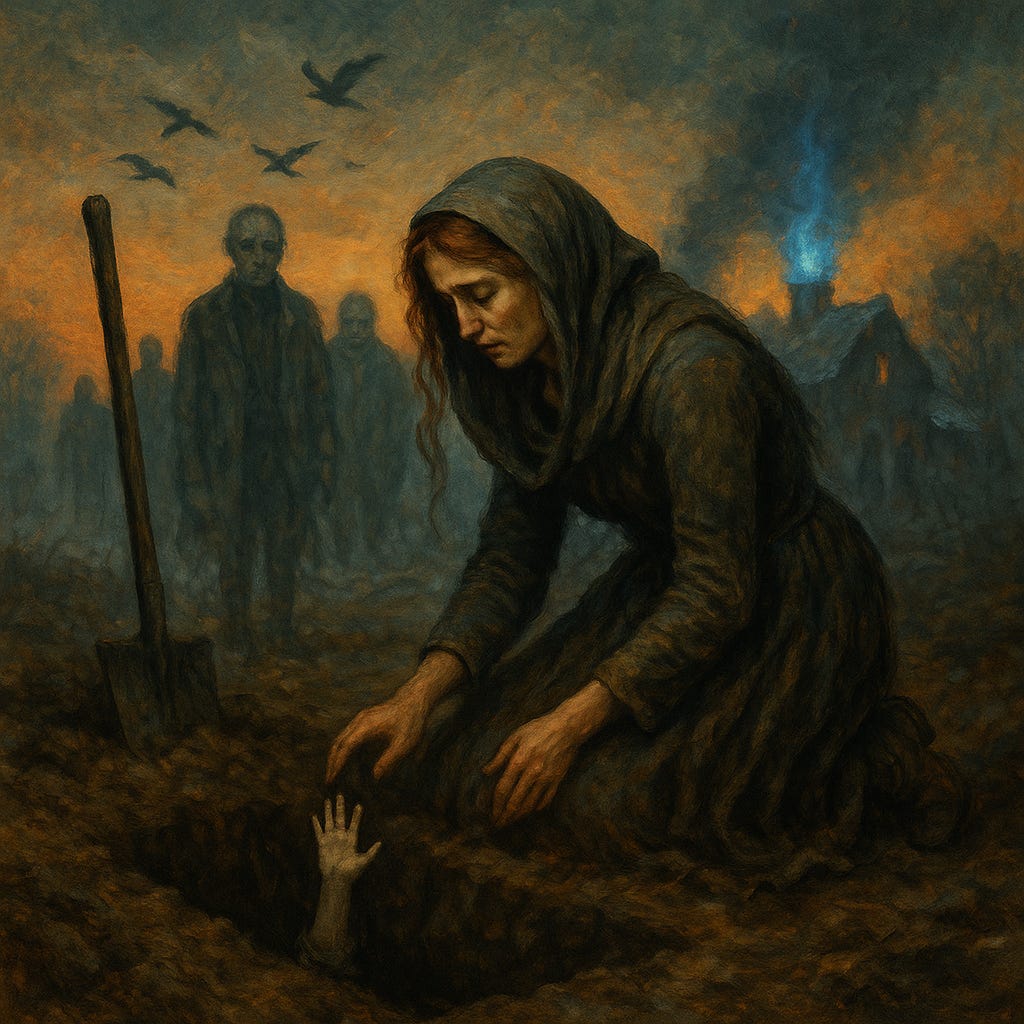
Samhain (pronounced “SOW-in”) marks the end of the harvest season in the ancient Celtic calendar, when the boundary between the living and the dead was believed to grow thin. On this night, October 31st into November 1st, the portals to the otherworld open and the dead could return to visit their families, who would leave offerings and light candles to guide them home.
When Irish immigrants fled to America during the Great Famine, they carried these traditions with them. What was once a night of spiritual meaning transformed into Halloween, though elements of the old fear and reverence still linger.
The Samhain Grave
She kept digging the grave as the sun sank behind the hill, the light that strange color and paleness that joined day and night. Her thin arms shook from the effort. Her hands were raw, palms blistered, her husband’s spade growing heavier with every stroke. When she finally stopped, the earth sighed and settled, as if exhaling.
It was Samhain, the night when the dead cross back. But she wasn’t thinking of that. She was thinking of Conor.
She had carried his small weight for days against her chest, his breath so faint she had counted heartbeats instead. When it stopped, she kept walking anyway, the wasted body warm for a little while, then not. She had walked all morning past cottages collapsed into their own smoke, past the black fields of rotting potatoes. The crows had followed her, a slow circling procession.
When the wind shifted, she could still smell the thatch burning on the hillside behind her. That morning, the soldiers had come with boots in the frost and English voices like the strike of steel on flint. The bailiff read her name from a folded paper, the last name left in the parish. She couldn’t understand the words, but she knew what he said. She had begged, but they didn’t look at her. They gestured for her to take what she could carry. She had nothing but Conor wrapped in her shawl as he weakly asked what was happening, and her husband’s spade slung on a string over her back.
When they set fire to the roof, it cackled like a banshee. The thatch twisted and spat and came down in sheets, the smoke rolling thick and bitter, smelling of turf and grief. By noon the whole row was gone, the hillside smouldering like a battlefield.
By evening she was alone with no husband, no neighbours, no priest to bless the ground. Just the sound of her own breathing and the earth waiting as she dug through the dusk. The spade struck roots, then stones, then something softer. When she stopped to rest, the crows went quiet and circled low, as if waiting on a signal. That was when she noticed the air had changed, colder now, and utterly still.
She brushed her hair back from her eyes and looked down at the child one last time. He was so small, his eyes sunken, his distended stomach painful to see. She whispered his name, only once.
The wind whispered it back.
She froze and listened. There it was again, a soft voice carried over the hill, speaking her name this time. At first she thought it was the wind, but then she heard boots on the path.
A figure stood at the edge of the field. Fergus. Her husband.
The breath left her. He’d been dead nearly a year, taken by the fever and buried in the churchyard before the priest himself had succumbed to the hunger. And yet here he was, walking toward her in the eerie light. His coat hung open, his face pale and sunken, his eyes dark as the soil she’d been digging. He didn’t speak. He just reached for the spade.
When he took it from her hands, she felt the chill move through the metal, as if something had passed between them. He began to fill the grave slowly, carefully, covering the body with clods of rotting earth.
When the grave was half full, another figure came from the mist. Her brother Liam. She had found him last winter by the river, face blue, mouth green from eating nettles by the roadside. Now he came walking over the rise, bloated, eyes milky, feet leaving no print in the mud. He took the spade from Fergus and kept filling the grave.
And then the others appeared. Old Máire, who had starved in her chair. Tomás, the boy who’d vanished after the fever took his mother. Even the priest, collar torn, fingers burned black from blessing too many bodies. They moved slowly, reverently, as though answering a call. Their clothes hung in tatters, their faces grey, but their eyes suddenly filled with a blue light.
She tried to speak, but her throat was dry. The wind rose, carrying the smell of peat and rot as smoke from the ruined cottages drifted down the hill, twisting around them. When the last of the soil fell, the wind stopped. The crows went silent. The night arrived all at once.
Fergus turned toward her, his mouth moving in what she thought was prayer until she realized he was saying her name. He held out his hand, fingers cold, cracked, black under the nails.
“Come home,” he said, the voice hollow, echoing from somewhere beneath the ground.
She stepped back. The earth behind her shifted with a soft wet sound as a hand broke through. Small and pale. Conor’s.
She dropped to her knees as the tiny fingers reached, grasping air, then touched her knee. The hand was warm. Her tears came hot and sudden.
“Please,” she whispered.
The others were closing in now, their faces calm, almost kind. Liam smiled the way he had when they played as children. Fergus stood just behind, eyes fixed on her with something like love. They weren’t pulling her. They didn’t have to. She could feel the earth beneath her knees beginning to soften, to give way like water.
She looked past them. The cottages burned still, but the flames were different now, blue and steady, like a beacon.
She understood then. It was Samhain, when the dead return to their hearths. When the veil between the living and the dead was thin.
Conor’s hand tugged again, gently. The soil crumbled at the grave’s edge. For the first time in weeks, she felt warmth, not in his touch, but in the promise of joining him, of ending the hunger, the cold, the terrible weight of surviving when everyone else had not.
She looked at his small fingers as they wrapped around her wrist. Then at Fergus, waiting. At all of them, patient as the earth itself.
She froze. Nothing moved. Even the wind seemed to hold its breath.
“No,” she said.
The word came out cracked, barely a whisper, but she said it again, stronger. “No.”
She pulled her hand free from Conor’s grasp. The warmth vanished instantly, replaced by a cold so sharp it burned. The child’s fingers reached again, desperate now, and she saw his face rise from the black earth. Mouth open in a silent cry that nearly broke her resolve.
“I carried you,” she told him, though she knew he couldn’t understand. “I carried you when you couldn’t walk. I’ll carry you still. But not like this.”
Fergus stepped forward. “There’s nothing left for you here. Only hunger. Only death.”
“Then I’ll be hungry.” Her voice grew steadier. “I’ll remember you hungry. I’ll speak your names hungry. But I’ll speak them.”
The light in their eyes flickered. Liam reached for her, and she saw confusion in his bloated features. They had never been refused before.
“Someone has to remember,” she said. “Someone has to tell it. The hunger. The burnings. Your names. If I go with you, who will know we were ever here?”
The dead stood perfectly still. Then, slowly, Fergus nodded. He understood. He had always understood her.
One by one, they turned away. Tomás first, then the priest, then old Máire. Liam lingered, his hand half-raised in farewell or beckoning. Fergus was the last to go, walking backward, keeping his dark eyes with the blue light on her until the mist swallowed him.
Conor’s hand withdrew into the earth. She wanted to grab it, to pull him back, to hold him one more time. Instead, she pressed her palms flat against the freshly turned soil and felt the last of his warmth fade into the ground.
She sat there until dawn, praying his name and all the others. When the sun rose, she stood on legs that barely held her. The spade lay where Fergus had dropped it. She picked it up, she would need it for walking, and perhaps for other graves.
The burned cottages still smouldered on the hillside. Somewhere beyond them was a road, and beyond that, perhaps, a place where the living still drew breath. She would find them. She would tell them. She would remember.
She looked back once at the small grave. “I’ll carry you,” she promised.
Then she walked toward the rising sun, the spade over her shoulder, leaving the dead to their rest, and carrying their names like seeds.
What a lovely story, beautifully written, Michael💛
This is one of your best stories
It’s easier to pass, but more important to carry the message, to remember