
Turlough O'Carolan: A Harper Between Two Irelands
The music that survived the fall of Gaelic Ireland

The horse knew the lane better than the guide did by the third visit, picking its way between the ruts while rain came in sideways off the Roscommon bog. Turlough O’Carolan sat straight in the saddle, he tilted his head to one side, listening. He could hear the river below the treeline before he could smell the turf smoke from the house. He smelled the smoke before the dogs announced him at the gate.
Inside, the evening was already well advanced. He could tell from the looseness in the voices that the drinking had been going on for a while. He was brought to the fire, his cloak taken, a glass pressed into his hand before he had fully settled.
The family spoke Irish to the servants and English to each other, the way people did in houses like this, navigating between two worlds in the same evening. They asked about the roads, about who he had visited, what news he carried from the east. A harper arriving was a kind of newspaper. He told them what he had heard: a fever in two townlands south of Strokestown, a land dispute near Boyle going badly for the Catholic side, a wedding in Sligo where the dancing went on until the candles burned to nothing.
Then someone asked him to play.
He settled the harp against his shoulder, the wire strings cold under his fingers for a moment before the room’s warmth reached them. He played a slow air first, the way you might ease into a conversation. Then a planxty he had composed for the Joneses of Meath, Protestant merchants who had fed him well two winters past. The music owed something to the Italian style he had been hearing in the drawing rooms of the big Anglo-Irish houses, the harmonies that had come in from the continent along with the new furniture and the wine. As the night became old and the fire was low, he could feel the room settling into something older. He played a modal air in the Gaelic manner, the kind of thing his teacher’s teacher might have played before the Flight of the Earls had emptied the Ulster courts.
Nobody in the room commented on the distance between the two kinds of music.
They didn’t need to. They lived with these two worlds every day.
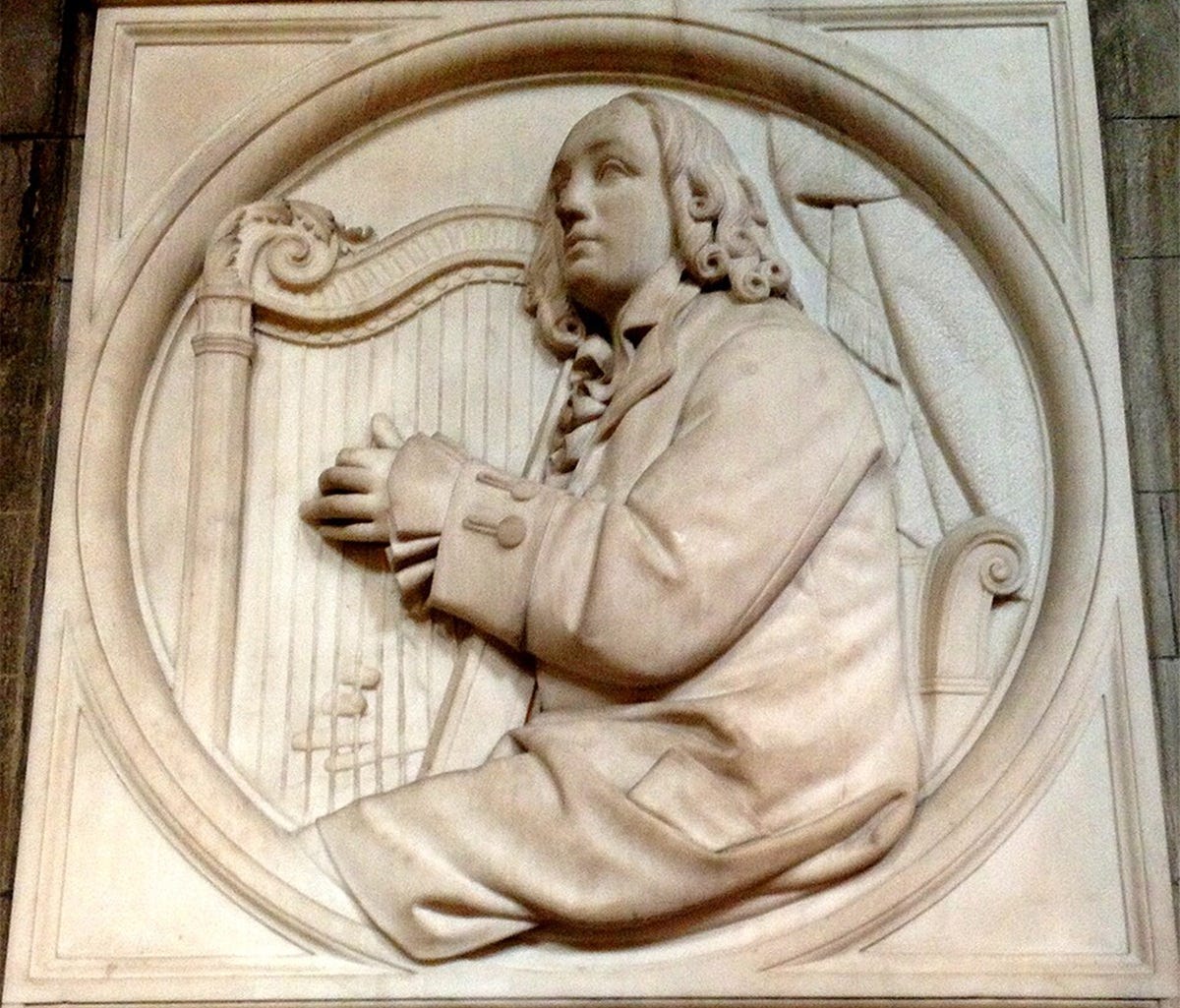
Turlough O’Carolan was born in 1670 near Nobber in County Meath, the son of a small tenant farmer, part of the Catholic Gaelic population living under increasingly difficult conditions. When he was still a boy, the family moved west to Ballyfarnon in County Roscommon, where his father found work with the MacDermott Roe family. They were a branch of the old Gaelic aristocracy who had managed to hold onto some of their land through the upheavals of the previous decades.
At eighteen he contracted smallpox. He survived but lost his sight. This would mean he could not work on the farm and might be confined to a life of dependence.
Through the MacDermott Roes he received training on the harp and, when he reached his early twenties, was given a horse, a guide, and he set out on the road that would occupy the rest of his life.
To understand what O’Carolan was travelling through, it helps to understand what Ireland had recently been.
The Gaelic world that had sustained the harpers for centuries operated on a principle that seems almost impossible to modern ears: that poetry and music were not entertainment but an essential structure of society. The hereditary filid, the learned poet class, held legal status equivalent to bishops. They preserved genealogy, recorded history, celebrated military victories, and destroyed reputations through satire with a precision that could take generations to repair. The harper accompanied the recitation of formal verse at court. Between them, the poet, the reciter, and the harper constituted a kind of cultural memory system for the Gaelic aristocracy. This was how families were remembered, legitimized, and sustained across time.
The bardic schools that trained the poets had been operating in Ireland since at least the 12th century. Their curriculum was punishing by any standard. It took twelve years minimum to attain the highest rank, and mastery of hundreds of metres. Students were given a subject at nightfall, then spent the following day in a darkened room composing entirely from memory. Only when evening came and the candles were lit did they write anything down.
The system produced something remarkable, a literate oral tradition, equally at home in manuscript and memory, that had survived Norman invasion, plague, and repeated political disruption for four centuries.
What it could not survive was the 17th century.
The defeat of the Ulster chieftains at Kinsale in 1601 broke the political independence of the last significant Gaelic lordships. The Flight of the Earls in 1607 removed the remaining great patrons from Ireland entirely. Ninety-nine Ulster lords and their families boarded ships at Rathmullan for the continent. Most of them would never return. The poets who had served them were left behind with their learning intact and nobody left who could pay for it. The Cromwellian conquest of the 1650s finished the job. Catholic landownership was devastated through confiscation and plantation. The remaining Gaelic families who might have sustained what was left of the old cultural system lost their land along with everything else.
By the time O’Carolan was born, Catholic families owned twenty-two percent of Irish land while comprising seventy-five percent of its population. By fifty years after his death, that land ownership would fall to five percent. The old Gaelic aristocracy, who had been patrons of harpers and bardic schools for centuries, were impoverished, scattered, or scrambling to adapt to the new order. The hereditary bardic schools had largely collapsed. The poets who had been trained in them were working as hedge schoolmasters or dying in poverty, writing laments for a tradition they watched dissolving in real time.
Dáibhí Ó Bruadair, probably the last poet trained in a classical bardic school, spent his final years doing agricultural labour. He died in 1698, the year O’Carolan was beginning to establish himself on the road. His poem D’Aithle Na bhFileadh — “The High Poets Are Gone” — had already said everything that needed saying about where things stood.
The Ireland O’Carolan travelled through was a land of tattered remnants and uneasy coexistence.
The great Gaelic houses that welcomed him were living in circumstances considerably diminished from their grandparents’ time. Their military power was gone, their political authority broken, their land confiscated. Irish remained the everyday language of rural Connacht and Ulster, but it was losing ground in the towns and among families who needed to navigate the new order. Songs, stories, and genealogies still passed from person to person around turf fires. Fragments of the old world survived but the formal structures that had sustained and organised that culture were gone.
The houses O’Carolan arrived at were navigating two worlds simultaneously, as the scene in any well-appointed Roscommon drawing room would demonstrate. Conversations moved between Irish and English depending on who sat at the table.
The new furniture from Dublin. The old Gaelic hospitality customs, maintained with a stubbornness that was partly pride and partly the only form of continuity available.
The other Ireland being built alongside this one was prospering considerably. The end of the Williamite war after 1691 had confirmed Protestant political dominance. The Penal Laws that followed restricted Catholic rights to land, education, and public life, with new legislation added throughout the 1690s and into the 18th century.
The major redistribution of land after the seventeenth century created substantial estates ruled by what would be called in Ireland, the Protestant Ascendancy. The small Anglican ruling class consisted of aristocrats, landowners, barristers, politicians, clergymen, military officers, all prominent professions that by practice and law had been closed to Catholics by the penal laws.
Dublin during O’Carolan’s career was transforming from a medieval town into something approaching a European capital, for the Ascendancy at least. Jonathan Swift held the deanship of St. Patrick’s Cathedral from 1713. Handel conducted the world premiere of the Messiah in the city in 1742. The great Georgian terraces were going up. For the members of the Ascendancy at least, Dublin was a city of elegance and wit and genuine cosmopolitan ambition.
O’Carolan moved between these two Irelands because he had no choice. Blindness had already taught him to navigate by what he could hear rather than what he could see. Though Catholic and rooted in Gaelic culture, he was welcomed in Protestant Anglo-Irish houses as readily as in old Gaelic ones. His music flattered and honoured his hosts wherever he found them. He composed tunes called planxties, named for patrons, “Planxty John Irwin,” “Planxty George Brabazon,” “Planxty O’Rourke”. The names alone tell you he was moving across a social landscape that the political situation had theoretically divided into opposing camps.
Over five decades on the road he composed lively tribute pieces for patrons and friends, lyrical airs with Irish-language words he wrote himself, and solemn laments marking deaths in the houses he visited. His work carried forward the older bardic function of elegy even as the institutions that had formalized it were long gone. More than two hundred tunes have been positively identified as his work.
What makes O’Carolan genuinely fascinating, rather than merely historically poignant, is what he did with what he heard.
The Baroque era was transforming European music during his lifetime. Corelli had reorganized how composers thought about harmony and musical structure. Vivaldi, Handel, and their contemporaries were producing work of a kind that had no precedent in earlier centuries. These sounds reached Ireland through the Anglo-Irish estates visited by O’Carolan. The Protestant Ascendancy maintained strong ties to London and the continent, bringing imported sheet music, and visiting musicians.
O’Carolan absorbed them. Pieces like Carolan’s Concerto carry clear Baroque influences, harmonic movement, and structural logic, woven into Irish harp music in a way that sounds entirely natural. The older modal qualities of the Gaelic harp tradition sit beside continental harmonic structures without apparent strain.
He was not a museum piece of vanishing Gaelic culture, and he was not a musician trading his inheritance for fashionable continental styles. He was something more interesting than either. He was a man who had absorbed both traditions so completely that he moved between them without apparent effort.
That is not a small thing. The formal Gaelic poetic tradition of the time had responded to political catastrophe largely by turning inward. The aisling poets of O’Carolan’s generation encoded their Jacobite politics in dream-vision references and yearned for a defeated Catholic Gaelic world. They composed elaborate laments for the lost world in traditional Gaelic forms, even as the audience who could appreciate such work shrank.
O’Carolan’s music crossed the line those poets could not or would not cross. It was heard and valued on both sides of the divide that the 17th century had cut through Irish life. That is partly why he survived as a working musician when so many of his poetic contemporaries died in poverty.
Within a few decades of O’Carolan’s death in 1738, the old harp tradition had contracted so dramatically that people feared it might disappear entirely. That fear produced the Belfast Harp Festival of 1792, where the surviving elderly harpers gathered so their music could be written down before it was gone. Edward Bunting sat beside them and notated what he heard. A remarkable portion of what he preserved were O’Carolan’s compositions, still being played by musicians who themselves represented the final generation of a tradition stretching back centuries.
You could spend a long time arguing about exactly what O’Carolan represents. The end of Gaelic Ireland. The survival of it. The point at which Irish culture absorbed a new world rather than being destroyed by it. He was probably all three at once, which is what makes him more interesting than the romantic image of the blind bard on the misty road.
He died at the home of the MacDermott Roe family, where it had all begun. Tradition holds that he asked for one final cup of whiskey before he went, so that two old friends might part in good cheer.
Thank you Michael for this important piece of Irish history. I knew the harp and harpists/harpers were an important part of Ireland’s history, but had no idea why. You did a wonderful job of explaining this through the story of O’Carolan life.
I always enjoy your enterwining of characters with Irish History...History passed down not only through grandparents but through traveling minstrels .. Looking forward to your next creation